HK Stocks Rally: AI Tech & Property Dual Engines Drive Market Confidence Rebound
\n
\n
Introduction
\n
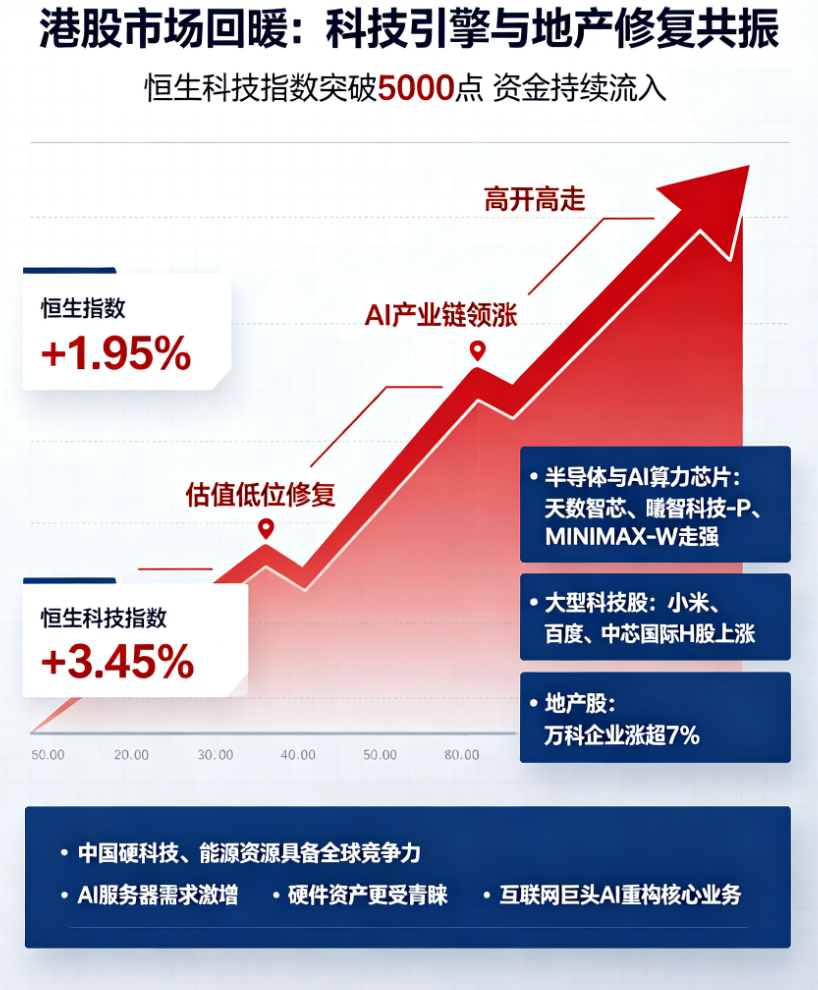
On July 21, 2026, the Hang Seng Index opened high and rose, with intraday gains once exceeding 2%, and the Hang Seng Tech Index crossed the 5,000-point mark, showing strong upward momentum. As of press time, the Hang Seng Index stood at 26,279.98, up 503.45 points or 1.95%; the Hang Seng Tech Index at 5,039.34, up 168.02 points or 3.45%. This rally was not accidental, driven collectively by the AI industry chain, large tech stocks, and the property sector. Market sentiment warmed significantly, capital continued to flow in, and HK's capital market is gaining new vitality.
\n
1. AI & Tech Stocks: Core Engine of the Rally
\n
Tech stocks were the core driver lifting the market. In AI computing and semiconductors, many stocks performed well. The new stock Tianshu Zhixin rose over 14%, with an intraday high of HK$555.5 per share, showing strong market interest in domestic AI chip companies. Xizhi Technology-P extended gains, rising over 18%; MINIMAX-W rose over 10%; Yangtze Optical Fibre and Cable and Xunce rose over 6%. These performances reflect the global AI industry chain shifting to China and the market's keen pursuit of hard-tech tracks.
\n
Large tech stocks also strengthened: Xiaomi Group-W rose over 9%, Baidu Group-SW over 5%, SMIC H shares and Sunny Optical Technology over 4%, NetEase-S and Bilibili-W over 2%. As AI large models and smart terminals become more integrated, tech giants are increasing AI infrastructure investment, from chip design to optical lenses, server hardware to cloud platforms. HK stocks cover key links of the full AI chain, making the market a crucial channel for global capital allocation to China's core assets.
\n
2. Property Sector Gains, Market Expectations Rise
\n
Besides tech, the property sector was also active. Vanke rose over 7%, becoming a market focus. This gain signals growing expectations of a property industry recovery. Recently, policies have steadily signaled stabilizing property and boosting consumption; multiple cities adjusted regulation measures, mortgage rates trended down, and developer financing conditions improved. Though the industry is still adjusting, strong performance of leading developers often indicates market confidence. Vanke's rally may suggest investors are increasingly recognizing the industry's bottom area.
\n
Meanwhile, specialized retail and insurance sectors also performed well, with broad-based gains. This broad rally shows capital is not concentrated in a single track but expects overall HK stock valuation repair. In a global low-interest-rate environment, HK stocks at historical lows offer strong appeal.
\n
3. Expert Views: Core Logic Unchanged, Undervalued Opportunities Evident
\n
Shao Jie Qu, Deputy GM of Great Wall Fund's International Business Dept, gave a positive assessment. He noted top investment banks still overweight Chinese assets (including HK stocks), with core logic unchanged. HK stocks are at historical lows; Chinese hard tech, energy, and resources have global competitiveness. As an offshore market, HK remains a key channel for global capital allocation to China's core assets.
\n
Qu emphasized that benefiting from AI development, AI software and hardware related sectors will perform well. Global cloud vendors expand capex, AI server demand surges. HK stocks cover the full chain from chip manufacturing, optical lenses, PCB to server hardware, with full orders and high earnings visibility. HK capital typically has lower risk appetite, favoring cash-flow, order-backed hardware assets over pure software stories. This makes HK tech stocks more solid with stronger valuation support.
\n
Additionally, internet giants use AI to reconstruct core businesses such as advertising, e-commerce, and cloud services, potentially improving efficiency and profits. After sufficient adjustments, valuations are at historical lows, offering high investment value. Historically, HK stocks at valuation bottoms often see extended repair rallies, and current conditions are ripe.
\n
4. Market Outlook: Capital Inflow Trend Likely to Continue
\n
Looking ahead, HK stocks face multiple positive factors. First, global liquidity tends to ease, the Fed's rate hike cycle nears its end, a weaker USD will drive capital back to emerging markets. HK, as a representative of quality Chinese assets, will benefit directly. Second, domestic economic recovery is becoming clearer; June's manufacturing PMI returned to expansion, key indicators like consumption and investment stabilized, providing macro support for corporate earnings improvement.
\n
At the industry level, AI domestic substitution accelerates. From chip design to advanced packaging, optical modules to servers, Chinese firms are taking more important positions in the global AI supply chain. HK-listed companies have tech barriers and customer stickiness, high order visibility, and strong earnings certainty. Though the property sector is still bottoming out, policy support is increasing, and quality developers may emerge from the trough first.
\n
From a capital flow perspective, southbound capital has been net buying recently, and foreign institutions' willingness to allocate to low-valuation HK stocks is also rising. HK Exchange data shows northbound net purchases expanded over the past month; after the Stock Connect mechanism further optimized, more international investors include HK stocks in core portfolios. If this capital inflow trend continues, it will provide sustained upward momentum for HK stocks.
\n
Conclusion
\n
This strong performance of the Hang Seng Index and Hang Seng Tech Index resulted from the combined force of AI tech, property, insurance, and other sectors. Market sentiment shifted from caution to positivity, capital inflow increased, and the valuation repair rally has begun. With AI chain expansion, marginal property policy improvement, and historically low valuations, HK stocks may see a medium-term structural rally. Investors should focus on hard-tech companies with core technology and order support, as well as fundamentally sound, reasonably valued leaders, seizing this market opportunity while controlling risks.
\n
(Full text approx. 1682 words)