Becamex IJC: Profit improvement, but market remains cautious
Keywords: Becamex IJC, profit growth, Binh Duong land bank, operating cash flow, capital increase, ROE, dividend, infrastructure investment, stock valuation, execution risk
For years, Becamex IJC (code IJC) has been a rather special case on the Vietnamese stock market. It holds a substantial land bank in the former Binh Duong area, now part of expanded Ho Chi Minh City, and has also built a reputation as a real estate stock with relatively stable and attractive dividends. However, the stock market story is never just about "having land" or "making profits". Investors increasingly focus on growth quality, the speed of asset conversion into cash, and whether capital returns are consistently improving.
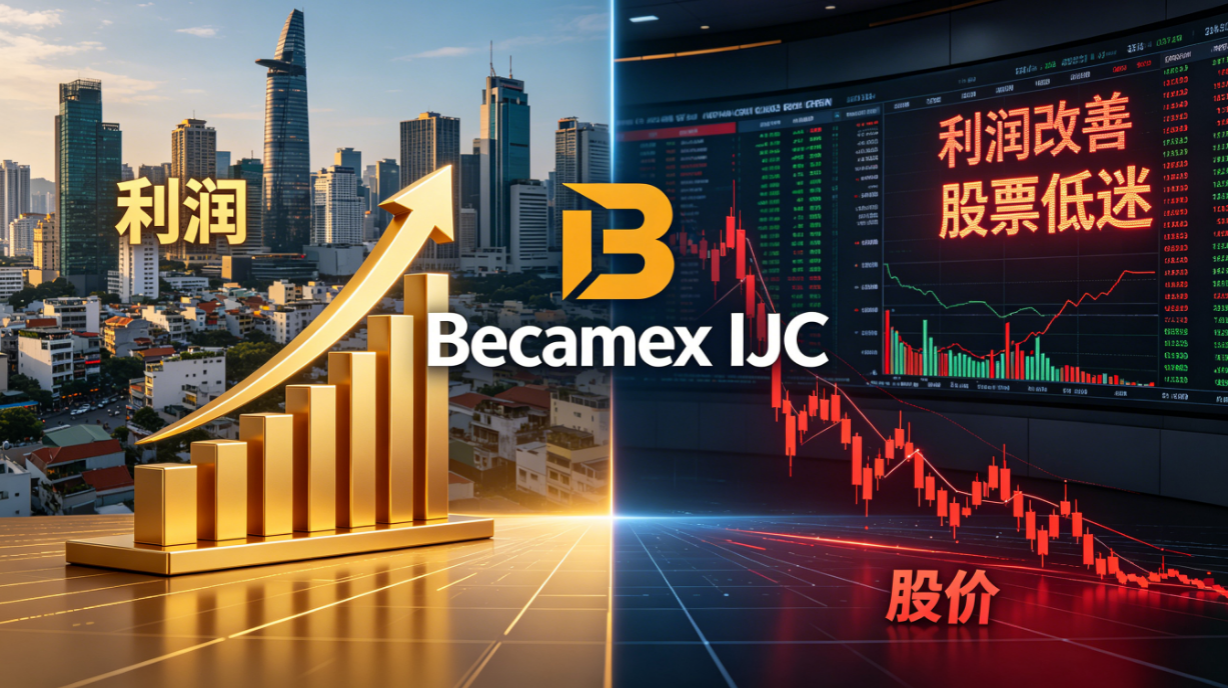
Therefore, despite Becamex IJC's recent notable improvement in operating performance, the stock price trend reflects a more cautious market attitude. This indicates that the biggest issue for IJC is no longer just revenue or profit growth, but proving that this growth is sustainable, efficient, and sufficient to navigate a new investment cycle.
Positive operating results not enough to change expectations
In Q1 2026, Becamex IJC recorded revenue of VND 2,535 billion, up 69.4% year-on-year. After-tax profit reached VND 1,043 billion, up 129.4% year-on-year, completing about 19.3% of the full-year profit target of VND 5,410 billion. On the surface, this is a very positive quarter, especially against a backdrop where the real estate market has not yet fully recovered its previous exuberance.
However, the stock market does not price a company solely based on one quarter's profit growth. Investors typically scrutinize the profit structure: where growth comes from, whether it is replicable, whether margins have truly improved, and most importantly, whether these accounting profits can be converted into cash.
IJC's stock performance partly reflects this skepticism. From the beginning of 2025 to the end of May 2026, IJC shares fell about 31.1%, from the VND 14,200 range to VND 9,790 per share. Meanwhile, the stock has been trading below the MA200 for a long time, and trading volume has not increased significantly. Technically, this usually indicates that the medium-term trend remains weak, and buying forces are insufficient to form a new valuation platform.
In other words, the market is asking: Profits are indeed better, but is this real growth or just periodic income recognized according to project progress?
Operating cash flow: a weakness investors cannot ignore
For real estate companies, especially project development and infrastructure firms, accounting profits often do not fully reflect financial health. A company may recognize high revenue and profits in a certain period, but due to capital expenditure for land bank, construction, site clearance, and development, operating cash flow may still be negative.
Becamex IJC clearly illustrates this contradiction. Despite significant profit improvement, the company's operating cash flow has been negative in recent periods: -VND 7,969 billion in 2024, -VND 2,323 billion in 2025, and continued at -VND 1,218 billion in Q1 2026. This is not uncommon in the real estate industry, but if it persists long-term, investors become more cautious in their view of the company.
For real estate firms, negative cash flow is not necessarily a bad signal, provided it accompanies an expansionary investment cycle and lays the groundwork for future revenue and profits. The key is that the capital recovery cycle must be clear, delivery progress must be solid, and capital use efficiency must be sufficient to cover opportunity costs. Otherwise, profit growth with low profit quality makes it difficult to support higher valuations.
From this perspective, the market wants to see not just "book profits" from IJC, but "real cash generation".
Land bank is an advantage, but does not automatically translate into value
One of Becamex IJC's most important assets is its land bank in the former Binh Duong area. This area concentrates many large industrial parks and cross-regional infrastructure such as VSIP, My Phuoc, and Tan Nguyen. The area lies on the largest industrial-urban development axis in the southern region and benefits from urbanization and infrastructure expansion driving land price appreciation, giving it strategic significance.
According to reports, as of the end of 2025, Becamex IJC had advanced 12 projects with a cumulative land bank of over 54 hectares. At a time when many real estate companies struggle to expand net land reserves, this figure remains compelling. If regional infrastructure continues to improve, local demand for housing, services, and commerce may rise further in the medium to long term.
But careful examination is needed: a land bank is a necessary condition, not a sufficient one. Its value depends on whether it can be converted into projects with complete legal procedures, products that meet market demand, and actual sales velocity. Many companies own large land areas but are stuck due to legal, land acquisition, or investment progress issues, ultimately failing to realize corresponding profits.
Becamex IJC's current strategy is no longer limited to residential real estate. The company is also participating or preparing to participate in large infrastructure projects such as Ring Road 4 of Ho Chi Minh City and the Ho Chi Minh City - Thu Dau Mot - Chon Thanh Expressway. This expansion allows the company to benefit from public investment and regional development cycles, but also brings greater capital needs, longer recovery periods, and more complex project management pressures.
New investment cycle brings capital increase and dilution issues
Companies entering large-scale investment cycles often face a choice between two objectives: maintaining high dividends to satisfy existing shareholders, or retaining profits and raising capital to seize growth opportunities. Becamex IJC clearly leans towards the latter.
Since the beginning of 2023, the company's charter capital was VND 2,518 billion. After two consecutive capital increases, by early 2026, charter capital had risen to VND 6,296 billion, an increase of about 150% in three years. In 2024, the company issued over 125.9 million shares to existing shareholders at VND 10,000 per share, raising about VND 1,259 billion. The following year, the company continued to issue over 251.8 million shares, raising an additional VND 2,518 billion.
Strategically, capital increases help companies obtain more resources for project development, reduce excessive debt pressure, and expand operational scale. However, from a shareholder perspective, capital increases always come with the risk of EPS dilution, ROE dilution, and changes in the structure of current and future interests. The market only accepts this dilution if it believes the new capital can generate returns above the cost of capital in the coming years.
For Becamex IJC, this is precisely the focus that the market is still weighing.
ROE decline is more concerning than revenue growth rate
Looking at the 2020-2021 period, Becamex IJC's ROE ranged between 18.96% and 22.94%, significantly higher than the real estate industry average at the time. This established the company's image as an "efficient capital user," supporting stock valuation and dividend policy.
However, when capital scale grows faster than operational efficiency, ROE typically weakens. This is a classic rule in financial analysis: if capital growth does not bring corresponding profit growth, returns gradually decline. At that point, even if revenue continues to grow, the market may assign a lower valuation because each unit of capital generates less profit.
Currently, IJC's forward P/E for 2025 is about 9.04x, below the industry average of about 14.47x. This gap indicates that the market is applying a significant discount, reflecting not only industry risk but also concerns about capital use efficiency and growth sustainability.
In short: revenue and profit growth are necessary, but the market needs high-quality growth.
Dividends: from attraction point to "shifting gears"
In the past, part of Becamex IJC's appeal came from its fairly generous dividend policy. Between 2018 and 2022, the profit distribution ratio to shareholders was typically high, ranging from 51% to 84% of after-distribution profits. Cash dividend rates were 12% in 2018, 10% in 2019, 15% in 2020, 16% in 2021, and 14% in 2022.
This created an image of a stock with both growth potential and stable cash flow for investors. However, after entering a new investment cycle, this policy has changed significantly. In 2025, the company expects a dividend of only about 5%. At the current stock price, the dividend yield is only about 5.1%, which is not significantly higher than long-term savings rates.
This is not necessarily a bad thing, but it means the company is prioritizing reinvestment over distribution. Investors must therefore choose between two mindsets: either accept short-term dividend sacrifices and wait for the long-term growth story, or demand that the company prove that retained capital creates value significantly greater than what would be distributed immediately.
Execution pressure greater than plan scale
Becamex IJC's investment plan for the coming years is quite aggressive. The company plans to invest VND 1,981 billion in corporate equity investments, notably contributing VND 1,078 billion to Ho Chi Minh City Ring Road 4 Joint Stock Company. In addition, the company plans to invest VND 3,620 billion for the upgrade and expansion of National Highway 13, VND 7,980 billion for civil and transport construction, and additional capital for existing real estate projects. The total investment plan for 2025-2030 amounts to trillions of VND.
Strategically, this is a transition from a land-focused company to one more deeply involved in infrastructure and urban development. However, as project scale increases, management capabilities become more critical: capital disbursement progress, payback periods, funding sources, and how to handle plan deviations will all be key issues.
As of March 31, 2026, Becamex IJC's total liabilities increased by about 271% compared to the beginning of 2020, reaching nearly VND 1,395 billion, equivalent to about 17.1% of shareholders' equity. For a real estate company, this leverage level is not high, but in the context of rapid capital growth, persistently negative cash flow, and huge investment needs, it still merits close tracking by investors.
Conclusion: IJC's story is essentially a story of value conversion
Becamex IJC is in an important transition phase. The company has quality land, strategic locations, a relatively clear portfolio of infrastructure and real estate projects, and recently more impressive operating performance. But the stock market rewards not just potential; it rewards the ability to convert potential into stable, predictable cash flow.
Therefore, it is not surprising that IJC's stock price has not yet fully reflected the profit improvement. Investors are waiting for stronger signals: improved operating cash flow, clear project progress, ROE recovery, controlled leverage, and profit growth stable enough to justify the new investment cycle.
In the long run, Becamex IJC's value will not come solely from land bank or capital scale, but from the ability to convert these resources into sustainable revenue, profits, and cash flow. That is ultimately the standard the market uses to price the company.