Hong Kong Tech Volatility and Gold Pullback: Investment Opportunities in Market Divergence
Introduction
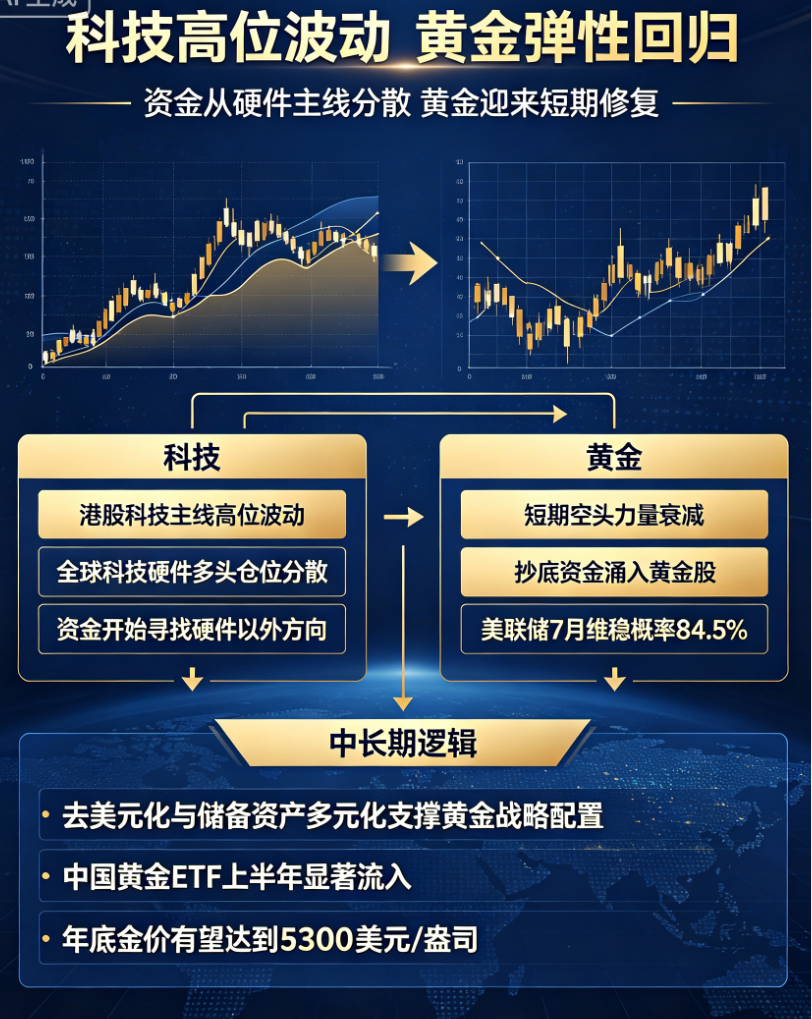
Recently, Hong Kong's tech sector has experienced high-level volatility after a sustained uptrend. Previously overly concentrated long positions in global tech hardware are gradually diversifying, with funds shifting to non-hardware sub-sectors. Meanwhile, after a deep pullback in international gold prices, short-term bearish momentum has weakened, and bargain-hunting inflows have driven gold stocks to show short-term resilience. Amid market sentiment divergence and slight changes in the macro environment, how to seize this round of structural opportunities has become the focus of investors.
Hong Kong Tech Main Line: From Concentration to Diversification
Over the past few months, hardware leaders in Hong Kong's tech sector have been directly driven by the surge in global AI computing demand, attracting massive capital inflows. However, as valuations rise, competition intensifies, and external trade environment uncertainties persist, overly concentrated long positions have started to loosen. Market funds are attempting to tilt toward areas beyond hardware, such as software services, cloud computing, and biotech, to diversify risks and seek new growth points. This trend reflects investors' perception of the tech main line shifting from "single hardware-driven" to "diversified ecosystem layout," and also indicates that rotation within Hong Kong's tech sector may accelerate.
Bullish Signals After Gold Pullback
The recent gold price pullback mainly stems from short-term speculative capital liquidation, not a reversal of fundamental logic. As bearish forces diminish, bargain-hunting capital quickly enters, rejuvenating gold stocks' resilience. Meanwhile, improved external liquidity conditions provide important support for gold price rebound. According to CME's "FedWatch" data, the probability of the Fed maintaining rates unchanged in July has reached 84.5%. The significant cooling of rate hike expectations means limited upside for the US dollar index, thus benefiting gold assets priced in US dollars.
Long-term Logic Unchanged; Central Bank Gold Purchases and ETF Inflows Support Outlook
Despite short-term price volatility, institutions remain optimistic about gold's long-term upward trend. Shanghai Securities noted that this year, energy commodity price fluctuations coupled with Fed rate hike expectations once suppressed gold prices, but increasing gold holdings as a risk buffer has become deeply tied to "de-dollarization" and reserve asset diversification, forming an important part of countries' top-level financial strategies. This long-term logic will not be shaken by short-term price pullbacks.
Data from the World Gold Council confirms this trend: in the first half of this year, gold ETFs in the Chinese market saw significant inflows, with total assets under management (AUM) slightly rising to 243 billion RMB, and total holdings increasing by 29 tons to 277 tons. This indicates that domestic investors' willingness to allocate gold remains strong, with safe-haven demand and asset preservation needs jointly supporting physical and financial demand for gold.
DBS Bank also believes that this round of gold price pullback is more about short-term speculative capital liquidation, and gold is expected to resume its core role as a safe-haven asset. Driven by long-term logic of continuous central bank gold purchases, unresolved global geopolitical risks, and lower real interest rates, gold still has upside potential this year. The bank expects gold prices to reach $5,300 per ounce by year-end.
Conclusion
The current market is in a complex stage where the tech main line diverges and gold experiences a short-term pullback. For investors, the structural rotation in Hong Kong's tech sector offers opportunities for diversified allocation, while gold, after bearish liquidation combined with improved liquidity and long-term accumulation logic, is building a new entry window. Before the macro environment becomes clear, an asset allocation strategy that balances growth and defensiveness may be key to navigating the volatility cycle.